Money talks with your partner shouldn’t feel like a negotiation between two strangers. But if you’re staring at two separate banking apps trying to figure out who paid the electric bill last month, that’s probably exactly what it feels like. The right budgeting app can turn those tense end-of-month conversations into a quick five-minute check-in — but only if you pick one that actually fits how your relationship handles money.

There isn’t a single "best" budgeting app for every couple. What works for a pair who’ve fully merged their finances looks nothing like what works for two people who keep separate accounts and just split the rent. Below is a breakdown of the top options for 2026, what each one does well, and how to figure out which one fits you.
Why Budgeting as a Couple Is Different
Budgeting solo means answering to yourself. Budgeting with a partner means two spending habits, two comfort levels around money, and often two very different definitions of "necessary." That mismatch is common — and it’s a real source of tension. According to The Penny Hoarder’s 2026 Financial Anxiety Barometer report, roughly one in three Americans say financial stress has caused tension or minor arguments with their significant other.
That friction usually isn’t about disagreeing on every purchase. It’s about each partner looking at different information and making decisions in the dark. A shared budgeting app fixes that by putting both people in front of the same numbers, in real time, instead of reconciling two separate mental spreadsheets once a month.
Before picking a tool, it helps to know what actually matters for couples specifically:
- Multi-user access without needing to share a single login or password
- Joint and separate account support, since most couples keep at least some money apart
- Privacy controls, so one partner can see the shared picture without seeing every personal purchase
- Real-time syncing, so both people are looking at current numbers, not last week’s
The Best Budgeting Apps for Couples in 2026
| App | Starting Price | Free Plan? | Best For |
|---|---|---|---|
| Monarch Money | $14.99/mo or $99.99/yr | No (7-day trial) | Couples who want a full shared financial dashboard |
| YNAB | $14.99/mo or $109/yr | No (34-day trial) | Couples who want strict, hands-on budgeting |
| Honeydue | Free | Yes, fully free | Couples who want the basics without paying |
| Goodbudget | Free / $10/mo or $80/yr | Yes, limited | Couples who prefer manual envelope budgeting |
Monarch Money: Best Overall for Shared Finances
Monarch is built around a shared household dashboard, and it’s the one that comes closest to giving couples a true joint financial command center. Both partners get their own login under one subscription that covers the whole household, priced at $14.99 a month or $99.99 a year, so there’s no per-person fee to worry about.
What sets it apart for couples specifically is the ability to connect both joint and individual accounts in the same view, then filter by owner when you want to see just your own transactions instead of the full household picture. That’s a meaningful privacy feature that a lot of comparison lists skip over. Monarch also tracks net worth and investments, which makes it a better fit for couples thinking beyond the monthly budget and toward longer-term goals.
The trade-off: there’s no free plan, and the depth of features can feel like overkill if all you want is a simple shared expense tracker.
YNAB: Best for Couples Who Want Real Structure
YNAB (You Need A Budget) runs on a zero-based method — every dollar gets assigned a job before you spend it. For couples, that means sitting down together and actually deciding, in advance, what the money is for, rather than reacting to whatever’s left over at the end of the month.
Pricing runs $14.99 a month, or roughly $9.08 a month when billed annually at $109 a year, and a single subscription can cover up to six people, which comfortably includes both partners. There’s a 34-day free trial with no credit card required, which is enough time to actually test whether the method sticks.
This one works best for couples who are comfortable with a bit of a learning curve and want discipline built into the system itself, rather than couples looking for something automatic and hands-off.
Honeydue: Best Free Option Built Specifically for Couples
Honeydue is the rare app that was designed for couples from the ground up rather than adapted from a solo budgeting tool. It’s completely free with no premium tier, connects to more than 20,000 financial institutions, and includes granular privacy settings so each partner controls exactly what the other one sees.
It also has built-in messaging and bill reminders, so you can comment on a transaction or nudge your partner about a due date without leaving the app. It’s not going to replace a full financial planning tool — there’s no investment tracking or long-term net worth modeling — but for couples who mainly want visibility into shared spending and bills, it covers the essentials without a subscription.
In my own experience, when money’s tight, the instinct to just grab the first "budgeting solution" you see can backfire. I’ve always paid close attention to comparing my options before committing to a tool or a cut in spending, because the cheapest-looking choice on paper isn’t always the one that actually saves you time or money once you’re using it day to day. That’s worth keeping in mind here too — the free app isn’t automatically the better deal if it means one of you stops opening it after a week.
Goodbudget: Best for Couples Who Want to Avoid Linking Bank Accounts
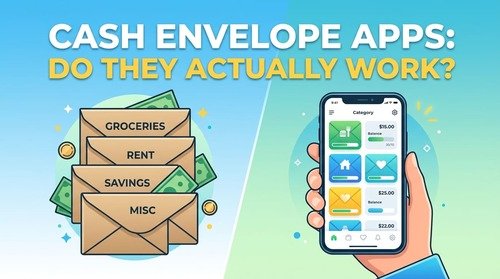
Goodbudget applies the classic envelope system digitally, and it doesn’t require connecting your bank accounts at all if you’d rather enter transactions manually. The free plan includes 20 total envelopes, one account, and two devices, which is workable for a couple just starting out. The Premium tier, at $10 a month or $80 a year, adds automatic bank syncing, unlimited envelopes, and support for up to five devices.
This is the pick for couples who are wary about connecting financial accounts to third-party apps, or who simply respond better to the tactile, "this envelope is empty" feeling than to an automated dashboard.
Worth a Mention: Zeta
Zeta takes a different approach by focusing specifically on couples who want to coordinate shared bills while keeping most of their finances separate. It’s not as comprehensive as Monarch or YNAB, but if full merging isn’t where you’re at as a couple, it’s built for exactly that in-between stage.
How to Choose the Right App for Your Relationship
There’s no universal winner here — the right pick depends on how your money is actually structured today, not how a budgeting influencer says it should be structured.
- Fully combined finances, want the full picture: Monarch Money
- Want structure and are willing to put in the setup time: YNAB
- Keeping things mostly separate but want visibility: Honeydue
- Prefer manual control and minimal bank connections: Goodbudget
- Somewhere in between joint and separate: Zeta
Whichever app you land on, the tool matters far less than whether both of you actually open it. A powerful app that only one partner checks isn’t a shared budget — it’s just one person’s spreadsheet with extra steps. Start with a short weekly check-in, even five minutes, and let the app be the thing you look at together rather than the thing one partner manages for the other.
Frequently Asked Questions
Do we need to combine our bank accounts to use a budgeting app together? No. Apps like Honeydue, Monarch Money, and Zeta are built to let couples view shared spending while keeping individual or joint accounts separate. You can share visibility without merging every account.
What’s the cheapest way to budget as a couple? Honeydue is free with no premium tier, and Goodbudget’s free plan covers basic envelope budgeting for one account. Both are reasonable starting points if you’re not ready to pay for a subscription.
Which app is best if one partner overspends more than the other? Apps with real-time notifications and shared visibility, like Honeydue or Monarch Money, tend to help the most here, since both partners see spending as it happens instead of finding out at the end of the month.
Can we switch apps later if one doesn’t work for us? Yes, and it’s common. Most couples try one app, learn what they actually need from a shared system, and switch to something that fits better. Don’t treat the first choice as permanent.
Money apps won’t fix a mismatch in financial values on their own, but they do make the day-to-day conversations a lot less tense. If you’re still working out the bigger-picture questions — like how to combine finances without one of you feeling boxed in — that’s worth exploring separately from picking a tool.