You’ve seen the videos. Someone sits at their kitchen table, sorts a stack of twenties into labeled envelopes, and swears it’s the reason they finally stopped overspending. It looks satisfying. It also looks like a hassle if you don’t want to carry cash everywhere, especially for a subscription or an online order. So the real question isn’t whether cash envelopes work — it’s whether an app can copy that same discipline without the trip to the bank.
What Cash Envelope Budgeting Actually Means
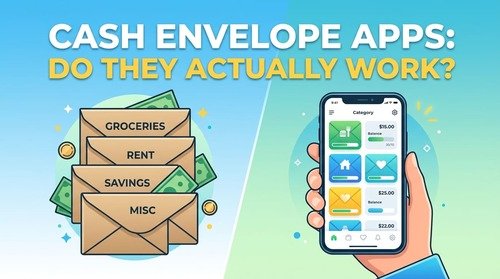
The envelope method is simple on paper. You take your income, divide it into spending categories — groceries, gas, dining out, entertainment — and put a fixed amount of cash into an envelope for each one. Once an envelope is empty, spending in that category stops until next month.
There’s no negotiating with yourself and no "I’ll just put it on the card this once." The limit is physical, so it’s hard to ignore.
This method has stuck around for decades because it removes a decision point. Instead of tracking what you spent after the fact, you decide in advance what each category is allowed to cost. As a result, overspending becomes something you’d have to work around on purpose, rather than something that just happens.
Why the Cash Part Matters (and Why Apps Try to Copy It)
Behavioral economists have long pointed to something called the "pain of paying" — the discomfort of physically handing over cash tends to make people think twice, more than tapping a card does. Cash makes the cost of a purchase visible and final in a way that a card swipe doesn’t.
Digital envelope apps are built to recreate that same friction without requiring actual bills. Instead of a paper envelope, you get a virtual category with a balance. Some apps go a step further and link a debit card that can only pull from the category you’ve selected before you spend, which is closer to true envelope behavior than a budgeting app that just tracks spending after the fact.
Cash use overall hasn’t disappeared, either. According to the Federal Reserve’s 2026 Diary of Consumer Payment Choice, cash remained the third most-used payment method in the U.S., involved in roughly one in seven payments, with debit and credit cards together covering about two-thirds of transactions. Cash use also skews older: a related 2024 Diary release found that consumers under 55 used cash for just 12% of their payments, compared with 22% among those 55 and older. That gap helps explain why so many younger budgeters want the envelope method without the actual paper.
Do Digital Envelope Apps Actually Recreate the Discipline?
Mostly, yes — with one caveat. An app that simply shows you a running balance per category (like a spreadsheet with nicer colors) gives you visibility, but not much friction. You can still overspend a category and just adjust the number later.
Apps that combine envelopes with real-time spending controls, like a debit card that blocks purchases outside your selected category, come closer to matching physical cash. The trade-off is usually a monthly fee and the friction of choosing a category before every single purchase, which some people love and others find tedious.
Comparing the Top Cash Envelope Apps
| App | How Envelopes Work | Free Plan | Paid Plan | Best For |
|---|---|---|---|---|
| Goodbudget | Manual envelope tracking; you log spending against categories yourself | Up to 10 envelopes, 1 account, 2 devices | Goodbudget Premium (unlimited envelopes and accounts, up to 5 devices, bank sync) | People who want the classic envelope method without linking a bank account |
| Qube Money | Digital envelopes ("Qubes") tied to a debit card that authorizes spending by category in real time | Lite plan, 3 Qubes | Premium ($12/month, or about $9/month billed annually) and Family ($19/month) plans unlock unlimited Qubes and shared access | Couples or families who want the physical-cash-style hard stop without carrying cash |
| YNAB (You Need A Budget) | Zero-based budgeting that functions like digital envelopes, even though it doesn’t use the word "envelope" everywhere | 34-day free trial, no permanent free tier | $109/year (or roughly $14.99/month) | People willing to actively manage their budget weekly for a more complete money system, not just envelopes |
It’s worth noting that YNAB’s own marketing states that the average user saves $600 in their first month and $6,000 in their first year. That’s a self-reported figure from the company rather than independent research, so treat it as a directional claim rather than a guarantee.
In my own experience, the real value of any of these tools isn’t the app itself — it’s what it forces you to do beforehand. I’ve always leaned toward comparing every option carefully before committing to a subscription, because the point of budgeting software is supposed to be saving money, not adding another recurring cost that quietly works against that goal. If a free plan like Goodbudget’s covers what you actually need, it’s worth trying before paying for extra features you might not use.
Where Envelope Budgeting Helps the Most
Envelope-style budgeting tends to matter most in the categories that make up the bulk of a typical budget. According to the U.S. Bureau of Labor Statistics' 2024 Consumer Expenditure Survey, housing accounted for 33.4% of average household spending, transportation for 17%, and food for 12.9% — together, over 60% of what the average household spends in a year. Because these categories are recurring rather than one-off, a hard limit per category can catch overspending before it snowballs, especially in flexible categories like food and transportation where costs vary month to month.
So, Do Cash Envelope Apps Actually Work?
For most people, yes — as long as the app matches how much friction they actually want. If you tend to overspend in a couple of specific categories (dining out is the classic one), an envelope-style limit creates a hard stop that a vague "spend less" goal never does. If you rarely open the app, though, no amount of envelope logic will help, because the method depends on checking your balance before you spend, not after.
The apps aren’t magic. They’re a structure. The same as physical envelopes, they only work if you actually use them.
FAQ
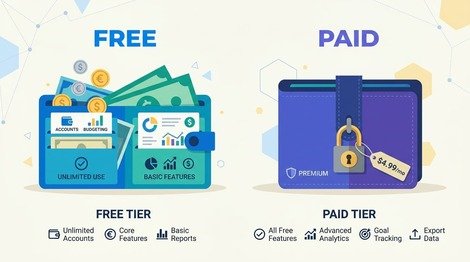
Are cash envelope apps free? Some are. Goodbudget offers a free plan with a limited number of envelopes, and Qube Money’s Lite plan is free with three envelope categories. Apps with more advanced features, like unlimited envelopes, bank syncing, or debit card integration, typically move you to a paid tier.
Do I need to link my bank account to use an envelope app? Not always. Goodbudget’s free plan works with manual entry, so you can track envelopes without connecting a bank account. Apps like Qube Money, on the other hand, are built around a linked debit card, so bank connection is part of how they function.
Is envelope budgeting better than a regular budgeting app? It depends on your spending habits. Envelope budgeting is particularly useful if you overspend in specific categories and need a hard stop. A more flexible tracking app might suit you better if you prefer reviewing spending after the fact rather than restricting it in advance.
Can I still use envelope budgeting if I mostly pay with a card? Yes — that’s the main reason digital envelope apps exist. They’re designed to recreate the limits of physical cash envelopes for people who pay with a debit or credit card rather than carrying bills.