You open your banking app, see a $5 fee you don’t recognize, and wonder why you’re still paying for the privilege of storing your own money. Meanwhile, a friend keeps telling you their online bank pays 40 times more interest than yours. So which one actually deserves your paycheck?
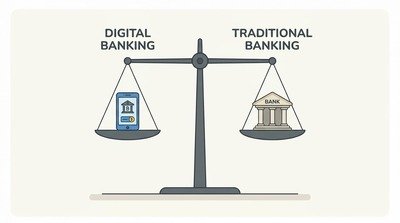
The honest answer is that neither option wins for everyone. Digital banks and traditional banks solve different problems, and the right choice depends on how you actually use your money day to day.
What Digital Banks and Traditional Banks Actually Are
A traditional bank operates physical branches, employs tellers, and usually has decades of brand recognition behind it. Because it carries the cost of leases, staff, and buildings, it tends to charge more and pay less in return.
A digital bank (sometimes called an online bank or neobank) exists mostly or entirely on an app or website. Without branches to maintain, it can pass those savings on to customers through higher interest rates and fewer fees.
Both types are typically insured the same way. As long as an institution is FDIC-insured, your deposits are protected up to $250,000 per depositor, per bank, per ownership category, whether that bank has one branch or none at all.
Digital Banks vs. Traditional Banks: Quick Comparison
| Feature | Digital Banks | Traditional Banks |
|---|---|---|
| Average savings APY | Often 3.5%–4.75% | National average around 0.63% (Bankrate, Aug. 2026) |
| Monthly maintenance fees | Frequently $0 | Average $5.47 for non-interest checking (Bankrate) |
| Branch access | None or very limited | Widely available |
| Cash deposits | Often difficult or indirect | Simple and direct |
| Customer support | Chat, phone, email | In-person, plus digital options |
| FDIC insurance | Yes, at insured institutions | Yes |
Neither column is automatically "better." It depends on which row matters most to you.
Where Digital Banks Win
Interest Rates That Actually Add Up
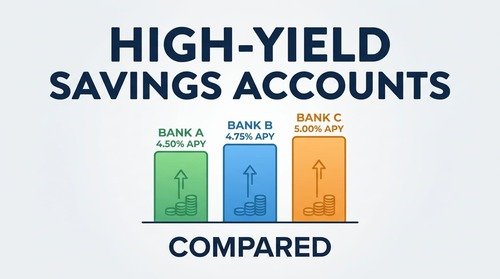
This is the clearest gap between the two. As of late August 2026, the national average savings account rate sits at just 0.63% APY, while many online high-yield savings accounts pay closer to 4% APY, according to Bankrate’s ongoing survey of institutions. On a $5,000 balance, that difference is the gap between earning about $31 a year and earning around $200. Because online banks skip the overhead of physical branches, they can afford to pay you more for the same FDIC-insured deposit.
Fewer Fees, Fewer Surprises
Digital banks generally build their entire product around avoiding fees, since it’s one of their main selling points against legacy institutions. Traditional banks, on the other hand, still commonly charge for basic account maintenance, and those charges quietly erode any interest you might be earning. If your current account nickels and dimes you every month, that alone might be reason enough to switch at least part of your money.
Speed and Convenience
Opening an account, transferring funds, or freezing a card usually takes minutes through a digital bank’s app, without a trip anywhere or a wait in line. For people managing money on a tight schedule, that convenience compounds over time.
Where Traditional Banks Still Win
Cash Deposits and In-Person Help
If you regularly handle cash — tips, a side business, garage sale proceeds — a traditional bank makes deposits simple. Most digital banks either can’t accept cash directly or require you to route it through a partner ATM network or another bank first, which adds friction exactly when you don’t want it.
Complex Situations Benefit From a Human
Mortgage applications, business loans, notarized documents, and estate matters often move faster with a banker sitting across the table from you. Some people also simply feel more confident discussing a serious financial decision face-to-face rather than through a chat window.
A Longer Track Record
Many traditional banks have operated through multiple recessions and financial cycles, which can matter to savers who value a long, visible history over a newer, app-only brand — even when both carry identical FDIC protection.
How to Decide Which One Actually Fits You
There’s no rule that says you have to pick only one. Plenty of people keep a traditional bank for everyday cash handling and branch access, while parking their emergency fund or savings goals in a high-yield digital account.
In my own experience, this exact kind of side-by-side comparison has shaped how I handle my own accounts. I’ve always paid close attention to where I can trim unnecessary costs without giving up quality or service, and switching part of my savings to a higher-rate option felt like an easy way to keep the security I wanted while getting more out of the same dollar.
Before deciding, ask yourself three questions:
- How often do I deposit cash? If it’s rare, a digital bank’s limitation matters less.
- Do I care more about growth or convenience of access? Rate-sensitive savers usually lean digital; frequent branch users usually lean traditional.
- Would I feel comfortable resolving a problem entirely through chat or phone? If not, keep at least one traditional account for backup.
Frequently Asked Questions
Is my money safe in a digital bank?
Yes, as long as the bank is FDIC-insured (or NCUA-insured if it’s a credit union). Your deposits are protected up to $250,000 per depositor, per institution, the same protection you’d get at a traditional bank.
Can I deposit cash into a digital bank account?
Usually not directly. Most digital banks require you to deposit cash at a partner ATM, a retail partner, or a linked account at another bank, then transfer the funds electronically.
Do digital banks have lower fees across the board?
Not automatically, but many are built around $0 monthly maintenance fees and no minimum balance requirements, which tends to make them cheaper than the average traditional account.
Should I close my traditional bank account and switch completely?
Not necessarily. Many people keep both — a traditional account for cash and in-person needs, and a digital account for higher-interest savings.
Whichever way you lean, the real win is making sure your money is actually working for you instead of just sitting there. If you’re ready to see how much a higher rate