Stashing cash in the same savings account you opened as a teenager might be costing you hundreds of dollars a year. Most big traditional banks still pay a fraction of a percent in interest, while online banks routinely pay ten times that — or more — for doing nothing riskier than parking your emergency fund somewhere smarter.
The tricky part is that "high-yield" doesn’t mean the same thing at every bank, and rates shift often enough that last month’s "best" pick isn’t always this month’s. Here’s how the top contenders actually stack up right now, and how to pick one without getting distracted by a flashy promo rate.
What Makes a Savings Account "High-Yield"
A high-yield savings account (HYSA) is simply a savings account that pays a meaningfully higher Annual Percentage Yield (APY) than the industry average. As of mid-2026, the national average rate for savings accounts is still just 0.38%, according to the FDIC. Meanwhile, top-tier online accounts have been paying well above 3%, sometimes touching the low 4% range. Yahoo Finance
Online banks can afford this because they skip the cost of physical branches. As a result, they pass more of that savings on to customers in the form of higher rates and fewer fees.
How These Accounts Compare
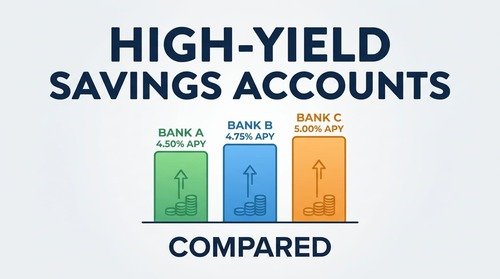
The table below reflects standard rates from three widely used online banks, based on rates reported in mid-to-late 2026. Because APYs are variable and can change at any time, always confirm the current rate directly on the bank’s website before opening an account.
| Bank | Standard APY | Minimum to Open | Minimum Balance for Top APY | Monthly Fees |
|---|---|---|---|---|
| CIT Bank (Platinum Savings) | 3.75% APY on balances of $5,000.00 or more; 0.25% APY on balances of $0.01 to $4,999.99 | $100 | $5,000 | None |
| Marcus by Goldman Sachs (Online Savings) | 3.40% APY | $0 | None | None |
| Ally Bank (Savings Account) | 3.00% APY | $0 | None | None |
A few things worth noting beyond the base rate:
- CIT Bank rewards larger balances but pays much less below the $5,000 threshold, so it’s best suited for people who already have some savings built up.
- Marcus and Ally apply their rate across the full balance with no tiers, which makes the math simpler if you’re still building your fund.
- Promotional rate boosts (like sign-up bonuses tied to a promo code) can temporarily push a bank’s advertised APY higher, but these usually expire after a set number of months. It’s worth reading the fine print so you’re not surprised when your rate drops back down.
What Actually Matters Beyond the Headline Rate
It’s tempting to just chase whichever bank has the highest number listed at the top of a comparison site. However, a few other factors can matter just as much for your day-to-day experience.
Access to Your Money
Most HYSAs limit withdrawals or transfers per statement cycle, and transfers to an external checking account typically take one to three business days. If you might need same-day access to your emergency fund, factor that delay into your decision.
FDIC Insurance
Any legitimate HYSA should be FDIC-insured (or NCUA-insured if it’s a credit union), which protects your deposits up to $250,000 per depositor, per bank. Before opening an account anywhere, confirm this coverage on the bank’s site — it’s non-negotiable.
Rate Stability Over Time
Some banks tend to move their rates up and down more aggressively depending on Federal Reserve policy, while others hold steadier. Because promotional rates can inflate a bank’s ranking temporarily, it’s worth looking at a bank’s rate history, not just today’s snapshot, before deciding it’s your long-term home for savings.
Ease of Use
A slightly lower APY at a bank with an app you’ll actually check, fast customer support, and simple transfers can beat a slightly higher rate at a bank that’s a hassle to deal with. In my own experience, when money gets tight, I don’t just chase the cheapest or highest-paying option blindly — I compare a few choices side by side and weigh where I’m actually getting the best overall value, not just the best number on paper. That habit has saved me from switching accounts constantly chasing a few extra dollars, only to lose time and convenience in the process.
How to Choose Between Them
If you’re deciding where to put your savings, a simple approach works well:
- Check your typical balance. If you’ll usually keep more than $5,000 in the account, a tiered account like CIT Bank’s could pay more overall.
- Decide how often you’ll move money. If you transfer funds frequently, prioritize a bank with a fast, reliable app and no complicated withdrawal limits.
- Compare current rates, not last month’s. Pull up each bank’s current APY side by side before opening anything, since these numbers shift with the broader rate environment.
- Confirm FDIC or NCUA coverage. This should be a five-minute check, not an afterthought.
Frequently Asked Questions
Is a high-yield savings account safe?
Yes, as long as it’s FDIC-insured (or NCUA-insured for credit unions) and you stay under the $250,000 coverage limit per depositor, per institution. Your principal isn’t at risk the way it would be in an investment account.
Do high-yield savings account rates change often?
Yes. Rates are variable and tied loosely to the Federal Reserve’s federal funds rate, so they can move up or down without much notice. It’s worth checking your rate every few months to make sure you’re still getting a competitive return.
Is it worth switching banks for a slightly higher APY?
It depends on your balance. On a small balance, the dollar difference between a 3.00% and 3.75% APY is minor. On a larger balance, that gap adds up meaningfully over a year, but factor in any hassle of moving direct deposits or automatic transfers.
Can I lose money in a high-yield savings account?
No, not through market risk. Your balance won’t drop due to a market downturn. The only way your real purchasing power can lose ground is if inflation outpaces your APY over time.
Comparing a handful of accounts side by side takes maybe ten minutes, and it’s ten minutes that can genuinely change how hard your emergency fund works for you. If you haven’t built that fund yet, it’s worth starting there before worrying about which bank pays the best rate on it.