You open your banking app, look at your balance, and have no idea why there’s less left over than you expected — again. If budgeting has always felt like too many spreadsheet columns and not enough clarity, the 50/30/20 rule might be the reset you need. It’s not a strict diet for your money. It’s a simple way to see, at a glance, whether your spending is roughly where it should be.
What Is the 50 30 20 Budget Rule?
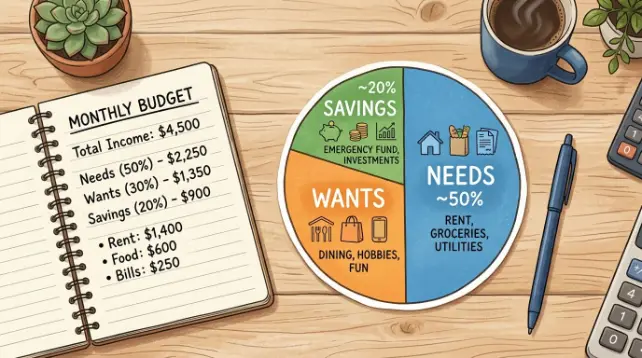
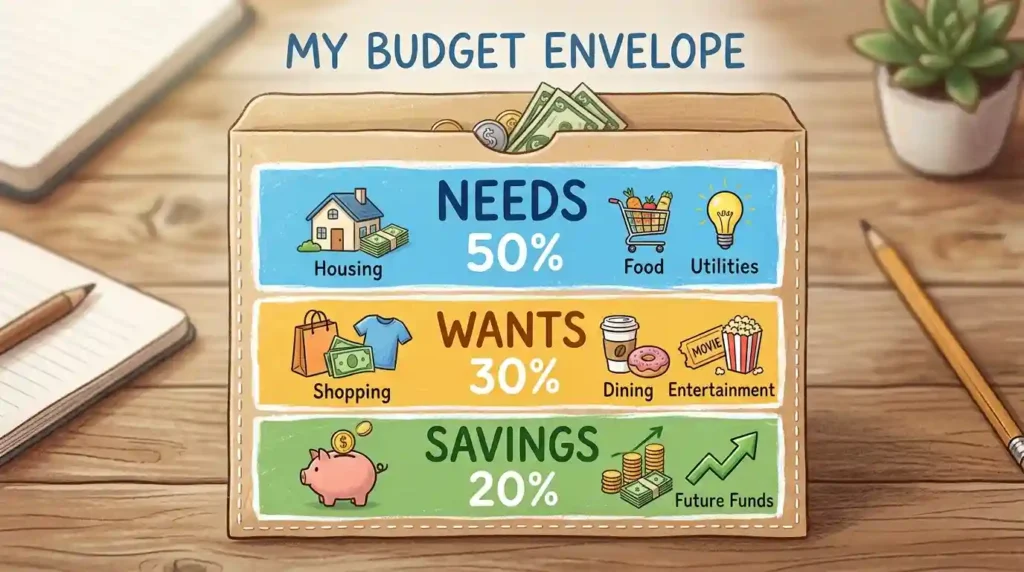
The 50 30 20 rule splits your after-tax (take-home) income into three buckets: 50% for needs, 30% for wants, and 20% for savings or debt repayment. The framework traces back to All Your Worth: The Ultimate Lifetime Money Plan, a 2005 book by then-Harvard law professor (and now U.S. Senator) Elizabeth Warren and her daughter, Amelia Warren Tyagi, who studied why so many middle-class families were struggling financially even as their incomes grew.
Their answer wasn’t complicated: most people simply didn’t have a clear, memorable way to know how much they could actually afford to spend. The 50/30/20 rule was built to fix that without requiring a finance degree or a dozen budgeting categories.
How to Calculate Your 50/30/20 Budget
Step 1: Find Your After-Tax Income
Start with what actually lands in your bank account — your paycheck after taxes, and after things like health insurance or retirement contributions are deducted. This is different from your gross salary, so don’t use the number on your job offer letter.
Step 2: Apply the Percentages
Once you know your monthly take-home pay, split it three ways:
- 50% – Needs: Rent or mortgage, utilities, groceries, minimum debt payments, insurance, transportation to work
- 30% – Wants: Dining out, streaming subscriptions, hobbies, travel, upgraded versions of things you don’t strictly need
- 20% – Savings or debt payoff: Emergency fund contributions, retirement savings, extra payments toward debt beyond the minimum
The math is intentionally simple. The goal isn’t precision to the dollar — it’s a sanity check you can run in your head.
Real 50-30-20 Budget Examples
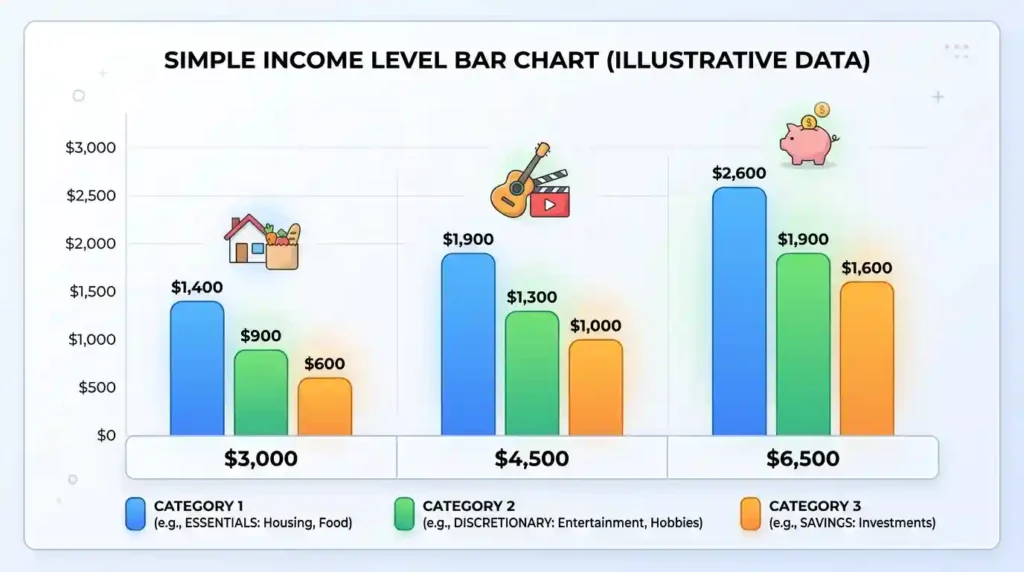
Seeing the percentages applied to real numbers makes the rule much easier to picture.
| Monthly After-Tax Income | Needs (50%) | Wants (30%) | Savings/Debt (20%) |
|---|---|---|---|
| $3,000 | $1,500 | $900 | $600 |
| $4,500 | $2,250 | $1,350 | $900 |
| $6,500 | $3,250 | $1,950 | $1,300 |
If you bring home $4,500 a month, for example, the rule suggests keeping rent, groceries, and other essentials at or under $2,250, capping discretionary spending at $1,350, and directing $900 toward savings or debt. If your actual numbers look wildly different from this, that’s useful information — not a failure.
What Counts as a "Need" vs. a "Want"?
This is where most people get tripped up, because the line isn’t always obvious.
Typically a need:
- Rent or mortgage payment
- Utilities and basic phone/internet
- Groceries (not takeout)
- Minimum debt payments
- Health insurance and necessary medications
- Transportation required to get to work
Typically a want:
- Restaurants, coffee runs, and delivery apps
- Streaming services and subscriptions
- Vacations and non-essential travel
- Upgraded or premium versions of things (a nicer car than you need, name-brand everything)
- Hobbies, entertainment, and gym memberships you could live without
A quick test: if cutting it would genuinely put your health, housing, or job at risk, it’s a need. If it would just make life less enjoyable, it’s a want — even if it feels essential in the moment.
What to Do When the Percentages Don’t Add Up
For a lot of people, especially in expensive housing markets, the 50% needs category is the first thing to break. Financial planners generally recommend keeping housing costs under roughly 25–30% of after-tax income on their own, which leaves very little room in the needs bucket for everything else once rent or a mortgage is that high.
This isn’t just a personal budgeting problem — it shows up in national data too. According to the U.S. Bureau of Economic Analysis, the personal saving rate across the country sat at just 2.7% as of June 2026, far below the 20% this rule recommends. In other words, hitting these exact percentages is aspirational for most households, not a baseline everyone is already meeting.
In my own experience, the percentages matter less than the habit of comparing where your money is actually going against where you’d like it to go. I’ve always leaned toward saving, but the real challenge shows up when income tightens — figuring out where to trim without settling for lower quality everywhere. That usually means comparing specific options (a cheaper grocery store, a better insurance rate) instead of cutting evenly across the board.
If your needs category runs over 50%, the most realistic fix is usually borrowing a few points from wants, not starving your savings category to zero. Even 5–10% saved consistently beats 20% attempted and abandoned after two months.
Common Adjustments to the Rule
The 50-30-20 rule isn’t the only version of this idea, and it doesn’t have to be treated as fixed. Some financial planners now suggest a 60/30/10 split for households where housing and other fixed costs simply take up more than half of income, shifting more room into needs and less into discretionary savings.
The percentages are a starting template, not a rule you’re failing if you don’t hit exactly. What matters more is that you have some deliberate split, and that you check in on it regularly instead of letting spending happen on autopilot.
FAQ
Is the 50/30/20 rule based on gross or net income? Net (after-tax) income — what actually deposits into your bank account, not your salary before taxes and deductions.
Does the 20% savings category include retirement contributions? Yes. Contributions to a 401(k), IRA, or similar account count toward your 20%, along with emergency fund savings and any extra debt payments beyond the minimum.
What if my rent alone takes up more than 50% of my income? You’re not alone, and it doesn’t mean the budget failed. Shift the split toward needs (many people land closer to 60/30/10 or 65/25/10) and treat the original 50/30/20 as a long-term target to work back toward, not an immediate requirement.
Is the 50/30/20 rule still realistic in 2026? It works best as a general framework rather than a precise formula, especially given how much housing and grocery costs vary by city. It’s most useful as a quick way to spot whether one category — usually wants — has quietly grown out of proportion.
Getting the split right on paper is one thing; sticking with it month after month is a different challenge entirely, and usually comes down to the systems you build around it rather than willpower alone.