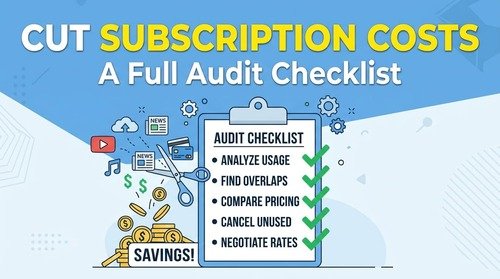
How to Start a Budget When You Have No Idea Where Your Money Goes
You check your account a few days before payday and wonder how it’s already this low. You didn’t buy anything "big." Nothing you can point to and blame. It just… went. If that sounds familiar, you’re not bad with money — you just don’t have a system yet, and that’s the first thing a budget actually fixes.
Why "I’ll Just Be Better About It" Doesn’t Work
Most people don’t fail at budgeting because they lack willpower. They fail because they try to control spending without first knowing what it actually looks like. It’s a bit like trying to lose weight without ever stepping on a scale — you can have good intentions and still have no idea if they’re working.
According to Debt.com’s 2026 Budgeting Survey, 85% of Americans say they budget, and nearly 88% of them say it’s helped them get out of debt or stay out of it. The gap between those who budget and those who don’t isn’t about income — it’s about visibility. Once you can see where money goes, you can decide where it should go instead.
Step 1: Find Out Where Your Money Is Actually Going
Before you build a single category or set a single limit, spend one full pay cycle just watching. Don’t change anything yet — just track it.
- Pull up your bank and credit card statements from the last 30 days
- List every transaction, even the small ones (coffee, app subscriptions, delivery fees)
- Group them into rough buckets: housing, food, transportation, subscriptions, "fun," everything else
- Don’t judge any of it yet — this is data collection, not confession
This step alone is often the most eye-opening part of the whole process. Most people underestimate one or two categories by a wide margin, usually food delivery or small recurring subscriptions that quietly add up.
Step 2: Calculate Your Real Take-Home Income
Budget off what actually lands in your account, not your salary on paper. If your income is irregular — freelance work, tips, commission — use your lowest realistic month from the past six as your baseline, not your best one. It’s easier to adjust upward in a good month than to scramble in a lean one.
Step 3: Choose a Framework That Matches Your Personality
There’s no single "correct" budgeting method — there’s the one you’ll actually stick with. A few starting points:
| Method | Best For | How It Works |
|---|---|---|
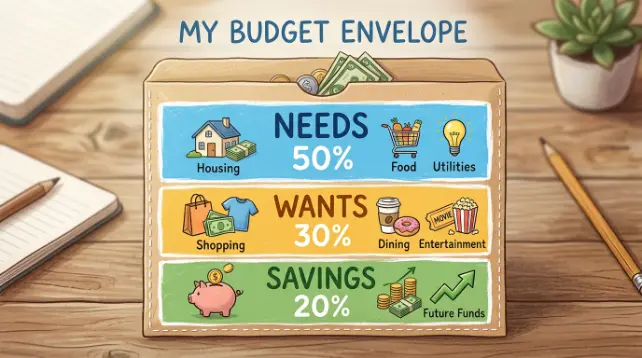
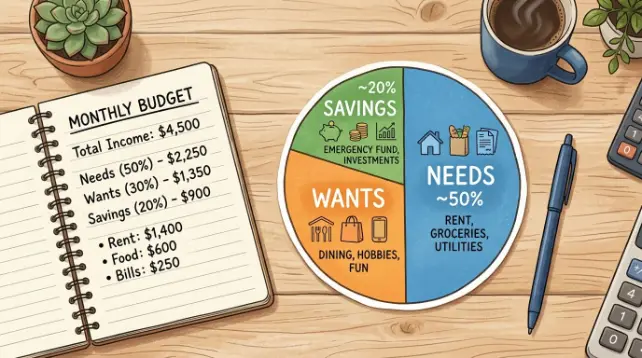
| 50/30/20 | Beginners who want simplicity | 50% needs, 30% wants, 20% savings/debt |
| Zero-based | People who like structure | Every dollar gets assigned a job until you hit zero |
| Pay-yourself-first | People who overspend before saving | Savings comes out automatically, you live on the rest |
If you’ve never budgeted before, start with 50/30/20. It’s flexible enough to survive real life and simple enough that you won’t abandon it in week two.
Step 4: Build Categories From What You Actually Spend
Skip the generic template categories and use the ones you found in Step 1. If you spend $40 a month on a rideshare app, that’s a category — not "miscellaneous." Vague categories are where budgets quietly fall apart, because "miscellaneous" has no limit and no accountability.
Set a realistic number for each category based on your actual recent spending, then adjust down slightly for the categories you want to shrink. Cutting a $600 grocery habit to $200 overnight isn’t a budget, it’s a setup for failure.
Step 5: Pick a Tracking Method You’ll Actually Use
The best budgeting tool is the one you’ll open again next week. Per WalletHub’s 2026 budgeting statistics, pen and paper remains the single most common budgeting method, which says something important: complexity isn’t what makes a budget work. Consistency does. Whether that’s a notes app, a spreadsheet, or a dedicated app, pick the lowest-friction option for how you actually live.
Step 6: Review Weekly, Not Just Monthly
A monthly check-in is too late to catch a problem while it’s still small. A five-minute weekly glance — what did I spend, what’s left in each category, anything surprising — keeps a budget from becoming a once-a-month source of guilt instead of an ongoing tool.
I’ve always leaned toward saving, but the real skill I’ve had to build isn’t just spending less — it’s figuring out where to cut without giving up things that actually matter. Once I could finally see my spending laid out clearly instead of guessing at it, comparison shopping and small substitutions stopped feeling like sacrifice and started feeling like strategy.
When Your Budget Doesn’t Work the First Month
It won’t, and that’s fine. The first month of any budget is really just a more accurate version of Step 1 — you’re still learning your real numbers. Adjust the categories that were unrealistic, keep the ones that worked, and try again. A budget is a living document, not a test you pass or fail.
Frequently Asked Questions
How much of my income should go toward a budget category? There’s no universal number, but the 50/30/20 split (needs, wants, savings/debt) is a reasonable starting point if you’re not sure where to begin. Adjust it based on your actual fixed costs, especially housing.
What if my income changes every month? Budget against your lowest recent month rather than an average, and treat anything above that as a bonus to put toward savings or debt. This keeps you from overcommitting in a slow month.
Do I need a budgeting app to make this work? No. Budgeting apps, spreadsheets, and pen and paper are all common methods according to WalletHub, and the "best" one is simply whichever you’ll actually keep using.
How long until a budget actually feels normal? Most people need two to three full cycles before it stops feeling like extra work and starts feeling automatic. Give it that long before deciding whether the framework fits you.
If tracking every transaction by hand still feels overwhelming, a simple spreadsheet template or budgeting app comparison can take some of that manual work off your plate.