You get paid, the money hits your account, and two weeks later you’re staring at your balance wondering where it all went. If that sounds familiar, you’ve probably heard someone suggest going back to cash envelopes — the same method your grandparents might have used before direct deposit even existed.
It sounds almost too simple for 2026. So does it actually hold up against apps, autopay, and a mostly cashless economy? Here’s what the envelope method really looks like today, and whether it’s worth your time.
What the Envelope Budgeting Method Actually Is
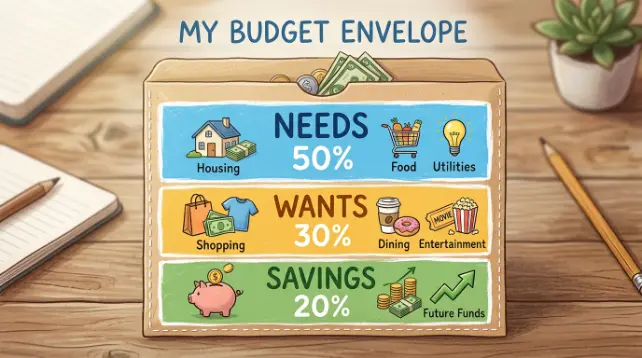
The envelope method is a cash-based budgeting system. You take your income, divide it into spending categories — groceries, gas, entertainment, and so on — and put the physical cash for each category into its own envelope. When an envelope runs out, spending in that category stops until the next pay period.
There’s no overdraft to lean on and no "I’ll just put it on the card." The cash you can see is the cash you have, and that’s the entire point.
Cash Envelopes vs. Digital Envelope Apps
Because plenty of people now do a version of this without ever touching paper money, it helps to see the two approaches side by side.
| Feature | Traditional Cash Envelopes | Digital Envelope Apps |
|---|---|---|
| Physical cash required | Yes | No |
| Works for online purchases | No | Yes |
| Visual/tactile spending cue | Strong | Moderate |
| Risk of loss or theft | Yes | No |
| Setup effort | Low | Moderate (linking accounts) |
| Best for | In-person, discretionary spending | Mixed online/offline spending |
Neither version is objectively "better." It depends on how much of your spending actually happens with a card versus a physical wallet.
Why the Envelope Method Is Having a Moment Again
If this feels like it’s suddenly everywhere, that’s because it is. A newer version of the method, often called "cash stuffing," has spread widely on social media, with creators filming themselves dividing their paycheck into labeled envelopes each month.
The renewed interest isn’t just a trend for its own sake, either. Federal Reserve data on how Americans actually pay for things backs up the idea that cash hasn’t disappeared, even as digital payments keep climbing. According to the 2026 Diary of Consumer Payment Choice, cash still shows up in 76% of consumer wallets, and 81% of people used cash for at least one payment in the prior 30 days. That’s a decline from a few years ago, but it’s far from irrelevant.
At the same time, the same report found the average consumer made just six cash payments per month in 2025, down from 14 back in 2016 — a sign that even people who still carry cash are using it more selectively than they used to. That’s roughly what the envelope method assumes: cash for a handful of specific, controllable categories, not for everything.
Does It Still Work in 2026?
Mostly, yes — but with real limits worth naming upfront.
Where it still works well:
- Impulse spending. Handing over cash feels different than tapping a card, and that friction is the whole mechanism. Once an envelope is empty, the decision is already made for you.
- Variable categories. Groceries, dining out, and "fun money" fluctuate month to month, which makes them a natural fit for a capped, visible amount of cash.
- Households that overspend on cards. If credit or debit spending consistently outpaces what was planned, physical cash removes the option to go over.
Where it runs into trouble:
- Online and subscription spending. You can’t stuff an envelope for streaming services or online shopping, so a pure cash system leaves gaps.
- Cashback and rewards. If you rely on a rewards credit card for points or cashback, switching whole categories to cash means giving that up.
- Physical risk. Cash can be lost or stolen in a way a bank balance can’t. That’s a real trade-off, not a minor inconvenience.
In other words, the method still works, but it works best as a partial system rather than a full replacement for your bank account.
Who the Envelope Method Fits Best
This approach tends to help most if you’re a visual, hands-on spender — someone who underestimates spending when it’s abstract, tracked only in an app or a statement that arrives weeks later. It also tends to help households recovering from a period of overspending, since the hard stop of an empty envelope removes the need for willpower in the moment.
It fits less naturally if nearly all your spending is already online, or if you’re trying to build credit and need to keep using a card regularly and responsibly.
In my own experience, this comes down to comparison and adaptability rather than picking one method and sticking with it forever. I’ve always looked for ways to cut costs without losing quality, which usually means comparing several approaches side by side instead of assuming one system fits every category of spending. For me, that’s meant using cash envelopes for the categories where I tend to overspend, while keeping a card for the fixed bills that don’t need that kind of friction.
How to Start an Envelope System This Week
- Pick two or three problem categories. Don’t convert your entire budget to cash on day one. Start with the areas where you consistently overspend, like dining out or shopping.
- Set a realistic cap for each envelope. Base it on your last two or three months of actual spending, not on what you wish you’d spent.
- Withdraw the cash once, at the start of the period. Weekly or biweekly works for most people, matching how often you’re paid.
- Label each envelope clearly and keep them somewhere you’ll actually see them, not buried in a drawer.
- When an envelope is empty, stop. If you’re tempted to "borrow" from another envelope, that’s a sign the caps need adjusting next time, not a reason to break the rule now.
- Review after one full cycle. Adjust the categories or amounts before locking in the system for the following month.
Frequently Asked Questions
Is the envelope method the same as cash stuffing? They’re built on the same idea. Cash stuffing is the modern, social-media-driven version of the classic envelope method, usually applied to a handful of discretionary categories rather than an entire budget.
Can I use the envelope method if I mostly pay with a card? Yes, by applying it only to specific categories, like groceries or entertainment, while keeping your card for fixed bills, subscriptions, and anything online.
What happens if I lose an envelope? That cash is generally gone, which is the biggest downside compared to a digital account. Many people manage this risk by keeping envelope totals modest and only carrying the current period’s cash.
Are digital envelope apps a good substitute? They can be, especially for online spending. They won’t replicate the physical friction of handing over cash, but they keep the same core idea of capped, visible spending categories.
Either way, the underlying habit matters more than the format. If you’re still working out how much to set aside before you even open your first envelope, it might help to look at how much of your income should realistically go toward saving in the first place.