Nobody’s report card ever had a section called "handling money." Yet most of us are expected to figure out taxes, credit, and debt the same week we’re figuring out how to do laundry on our own. That gap between what school prepares you for and what adulthood actually demands is exactly why so many people feel behind on money, even when they’re smart, capable, and doing "everything right" everywhere else.
The good news is that this gap is shrinking, slowly. As of 2026, roughly 30 states require a standalone personal finance course for high school graduation, up from just a handful a few years ago. But if you already graduated before your state caught up, you’re stuck learning these lessons the hard way, usually through a mistake that costs real money. Here are the ones that tend to hit hardest.
Lesson 1: Money Is Emotional, Not Just Mathematical
School treats money like a math problem: add income, subtract expenses, balance the equation. In real life, money is rarely that clean. It’s tangled up with stress, self-worth, and how safe you feel about the future.
In my own experience, I’ve noticed that money affects my mood far more than I’d like to admit. When things are going well financially, everything else feels more manageable, too. When they’re not, that anxiety creeps into confidence and focus in ways that have nothing to do with spreadsheets. I think this is especially true for young men, who often carry financial stress quietly instead of talking about it. Nobody teaches you that the emotional side of money is just as real as the numbers, so you end up thinking something is wrong with you instead of realizing it’s a completely normal part of managing finances.
Recognizing this pattern is the first step toward managing it. Once you can name the anxiety instead of just feeling it, it becomes something you can plan around, rather than something that quietly runs your decisions.
Lesson 2: Interest Works Two Ways, and Nobody Explains Both
Most people leave school with a vague idea that interest exists. Far fewer understand how differently it behaves depending on which side of it you’re on.
When interest works for you, such as in a high-yield savings account, it grows your money slowly and predictably over time. When it works against you, such as on a credit card balance, it compounds in the opposite direction. Because the average credit card annual percentage rate sits close to 21%, carrying even a modest balance can quietly cost hundreds of dollars a year in interest alone. As a result, understanding which side of that equation you’re standing on changes how urgent a decision actually is.
This is also why paying off high-interest debt often matters more than trying to save and invest at the same time. The math almost never favors doing both equally.
Lesson 3: A Budget Isn’t a Punishment, It’s a Plan
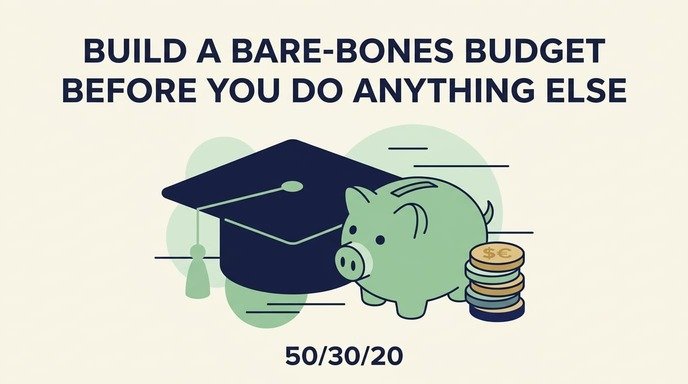
Somewhere along the way, "budget" became a word associated with restriction, as if it only exists to stop you from having fun. In reality, a budget is closer to a map. It shows you where your money is already going so you can redirect it on purpose, instead of wondering at the end of the month where it disappeared to.
A few things make budgeting click for people who never learned it formally:
- Start with what you actually spent last month, not what you think you should spend.
- Build in a small amount for fun, because a budget with zero flexibility rarely survives contact with real life.
- Revisit it monthly, since income and expenses shift more than most people expect.
None of this requires a finance degree. It requires honesty about your numbers and a willingness to adjust them.
Lesson 4: Your Credit Score Follows You Everywhere
Credit scores rarely come up in a classroom, yet they quietly influence far more than whether you get approved for a credit card. Landlords, insurers, and even some employers factor credit history into their decisions, so a score built (or damaged) in your early twenties can follow you for years.
The habits that build strong credit are simpler than the topic sounds: pay on time, keep balances low relative to your limits, and avoid opening too many accounts at once. However, the mistakes that damage it, like a single missed payment, can take much longer to undo than they took to create. Because of that asymmetry, it’s worth treating your credit score as something to protect early, rather than something to fix later.
Lesson 5: An Emergency Fund Isn’t Optional, It’s Infrastructure
School teaches you to save for goals: a car, a trip, a house. It rarely teaches you to save for nothing in particular, which is exactly what an emergency fund is for.
The numbers explain why this matters. Fewer than half of Americans say they have enough liquid savings to cover a $1,000 emergency expense, according to a Bankrate survey. That means for most people, a car repair or a surprise medical bill doesn’t just cost money; it forces a choice between debt and going without something essential. An emergency fund breaks that cycle by turning a crisis into an inconvenience.
You don’t need a large cushion to start. Even a small buffer, built slowly and left untouched, changes how stressful an unexpected expense feels when it eventually shows up.
Lesson 6: Debt Has a Psychological Cost, Not Just a Financial One
Textbooks explain interest rates and repayment terms. What they leave out is how debt actually feels: the low hum of stress that shows up when you check your balance, or the way it narrows your sense of choice in everyday decisions.
For context on the scale of the issue, the average American now carries about $6,600 in credit card debt, based on recent TransUnion data. Because that debt sits on high interest, it tends to grow quietly if it’s only ever paid at the minimum. On the other hand, being debt-free doesn’t just save money; it removes a layer of obligation that can weigh on decisions far beyond your bank account, from which job you feel free to take to how much risk you’re willing to accept.
FAQ: Money Lessons and Financial Literacy
Why don’t schools teach personal finance? Curriculum requirements vary by state, and personal finance has historically competed with other required subjects for classroom time. That’s changing, though implementation timelines differ widely depending on where you live.
What’s the most important money lesson to learn as an adult? There’s no single answer, but understanding how interest compounds, in both directions, tends to have the biggest impact on long-term financial decisions.
Is it too late to learn these lessons if I’m already in my 30s or 40s? No. Financial habits can be rebuilt at any age, and small, consistent changes tend to matter more than when you start.
How can I teach myself what school didn’t cover? Reputable personal finance blogs, library resources, and free budgeting apps are a practical starting point. The goal isn’t to become an expert overnight, just to close the gaps one habit at a time.
Where to Go From Here
None of these lessons require perfection, just awareness. Most people aren’t behind because they’re bad with money; they simply never had a chance to learn the parts that matter most. Building financial confidence often starts with the basics, like understanding where your money actually goes each month.