You check your bank balance before you swipe your card, not after. Payday feels less like relief and more like a brief pause before the next round of bills starts pulling money back out. If that sounds familiar, you’re not imagining things, and you’re definitely not alone.
Nearly half of Americans are still living this way. According to Debt.com’s 2026 Budgeting Survey, 48% of Americans reported living paycheck to paycheck this year. That’s actually a sharp improvement from 69% in 2025, but it still means close to one in two people has almost no room to absorb a surprise expense.
The good news is that the cycle isn’t a personality flaw. It’s a pattern, and patterns can be interrupted.
What "Paycheck to Paycheck" Actually Means
The phrase gets used loosely, so it helps to define it clearly. Living paycheck to paycheck means most or all of your income goes to essentials each month, leaving little or nothing left over once bills are paid.
It doesn’t only happen to people who earn too little. Plenty of higher earners fall into it too, because expenses tend to rise right alongside income. As a result, the real issue is often the gap between income and spending, not the size of either number on its own.
Why the Cycle Is So Hard to Break
The paycheck-to-paycheck cycle sticks around because it’s self-reinforcing. Without a buffer, every unexpected cost — a car repair, a medical copay, a rent increase — has to be absorbed immediately, usually by credit or by borrowing from next month’s budget. That, in turn, guarantees the next paycheck is already spoken for before it arrives.
This isn’t just a math problem, either. It carries a real emotional weight. In my own experience, money has been tied less to how much I actually have and more to how steady it feels — when things are tight, that instability shows up as genuine anxiety, and it’s hard not to let it affect your mood and confidence day to day. That’s a common experience, especially for people in their 20s and 30s who are managing money on their own for the first time.
Federal Reserve data backs up how thin that margin really is for a lot of households. In the 2025 Survey of Household Economics and Decisionmaking, only 63% of adults said they could cover a hypothetical $400 emergency expense using cash or its equivalent. Just 55% had savings set aside to cover three months of expenses.
Step 1: Get an Honest Read on Where Your Money Goes
Before changing anything, you need real numbers instead of a rough guess. Pull the last two months of bank and card statements, then sort every transaction into a handful of categories: housing, food, transportation, debt payments, and everything else.
Most people find at least one surprise in this exercise. A subscription they forgot about. A grocery bill that’s crept up without anyone noticing. As a result, this step alone often reveals where the first fix should happen.
Step 2: Build a Tiny Buffer Before You Build a Full Emergency Fund
The standard advice is to save three to six months of expenses. That’s a great long-term goal, but it’s also so far away for someone living paycheck to paycheck that it can feel pointless to even start.
A smaller, faster target works better here. Aim for $500 to $1,000 first. Because that amount is realistic within a few months, it’s far more likely to actually get saved, and it’s usually enough to cover the small emergencies that would otherwise land on a credit card.
Step 3: Fix the Leaks Before You Touch Your Income
It’s tempting to jump straight to "I need to earn more." However, earning more rarely solves the cycle on its own if spending simply rises to match it. Fixing the leaks first makes any future income increase actually count.
Look specifically for:
- Subscriptions or memberships you’re not using regularly
- Recurring fees (bank fees, late fees, unused insurance add-ons)
- Grocery and dining spending that’s crept up gradually
- Any recurring "small" purchase that adds up to a large monthly total
None of these fixes need to be dramatic. Even trimming $100 to $150 a month, redirected consistently, starts to change the shape of the cycle.
Step 4: Automate the Habit, Not Just the Budget
Willpower runs out. Systems don’t. Once you’ve found even a small amount to redirect, set up an automatic transfer to a separate savings account on payday, before you have a chance to spend it.
This single habit does more long-term work than almost any other budgeting tip, because it removes the decision entirely. The money moves before it becomes "available" in your mind.
When the Cycle Isn’t About Habits
It’s worth being honest here: sometimes the paycheck-to-paycheck cycle isn’t primarily a spending problem. If your income genuinely doesn’t cover basic needs even after cutting every non-essential, the fix has to include increasing income, not just tightening a budget that’s already tight.
In that case, the steps above still help, but they work alongside — not instead of — looking at ways to raise your income, whether through a raise, a role change, or extra work on the side.
Frequently Asked Questions
How long does it typically take to break the paycheck-to-paycheck cycle?
It varies widely depending on income, expenses, and debt load, but most people who track spending and automate savings see a real shift within three to six months.
Is it normal to feel anxious about money even when I’m not in debt?
Yes. Financial anxiety is common even among people with no debt, especially when there’s little cushion between income and expenses. Building even a small buffer tends to ease that feeling noticeably.
Should I pay off debt or build savings first if I’m living paycheck to paycheck?
A small starter buffer of $500 to $1,000 first, then debt payoff, then a full emergency fund, is a common and practical order — it prevents new debt from unexpected expenses while you tackle existing balances.
What’s the fastest way to find extra money in a tight budget?
Auditing subscriptions and recurring fees usually surfaces the fastest wins, since that money is already leaving your account without much thought.
Closing Thought
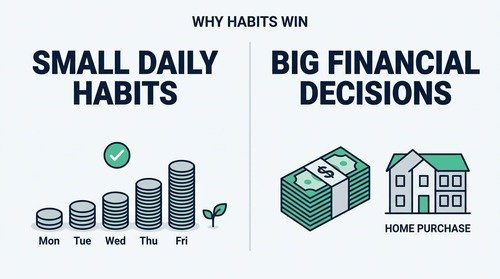
Breaking this cycle rarely comes down to one big change. It’s a handful of small, repeatable habits — a smaller starter savings goal, a closer look at where money leaks out, an automatic transfer that removes the decision-making. If you’re also working on your budget from scratch, it’s worth reading through the basics of building one before layering on these steps.