You can hand two people the exact same bank balance, and one will feel like the walls are closing in while the other feels perfectly steady. That gap usually has less to do with the number itself and more to do with the mental script running in the background. That script has a name in psychology: scarcity mindset versus abundance mindset.
What a Scarcity Mindset With Money Actually Looks Like
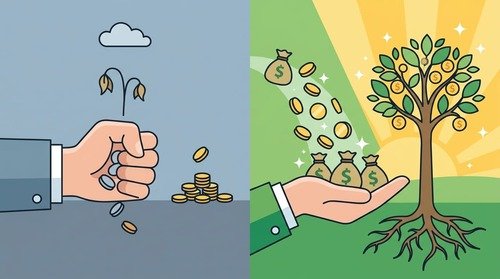
A scarcity mindset is the belief, often unconscious, that there will never be enough — not enough income, not enough savings, not enough opportunity. It’s not the same as simply having a tight budget. You can be broke without a scarcity mindset, and you can earn a comfortable salary while still operating from one.
People with a scarcity mindset tend to:
- Hoard money out of fear rather than intention, even when it hurts their quality of life
- Make short-term decisions because the future feels too uncertain to plan for
- Avoid looking at their bank account or bills because the anxiety feels worse than not knowing
- View other people’s financial success as proof there’s less available for them
None of this makes someone weak-willed or bad with money. In many cases, it’s a rational response to a genuine history of not having enough.
What an Abundance Mindset Is (and What It Isn’t)
An abundance mindset is the belief that resources, opportunities, and options can expand — that a setback today doesn’t have to define next year. Importantly, this is not the same as reckless optimism or ignoring your bank balance because "it’ll work out."
A healthy abundance mindset still budgets, still checks account balances, and still plans for emergencies. The difference is that decisions come from a place of "how do I build toward more" rather than "how do I protect against loss."
How Scarcity Actually Changes the Way You Make Decisions
This isn’t just a motivational-poster concept. Behavioral economist Sendhil Mullainathan and psychologist Eldar Shafir spent years studying what happens to the brain under financial pressure, and their findings explain a lot about why money stress feels so hard to think your way out of.
In one widely cited experiment, researchers asked people to imagine unexpected car repairs of different sizes while taking cognitive tests. When the hypothetical repair was small, wealthier and lower-income participants performed about the same. But when the repair was large, lower-income participants' performance dropped sharply, by an amount comparable to roughly a full night of lost sleep, according to Simply Psychology’s summary of the research. Wealthier participants weren’t affected at all by the same prompt.
The researchers call this a "bandwidth tax." As a result, worrying about money doesn’t just feel unpleasant. It actively uses up the mental resources you’d otherwise use for planning, self-control, and clear decision-making, which is one reason financial stress can trap people in it rather than motivating them out of it.
This matters because a scarcity mindset isn’t only a feeling. It measurably changes the quality of the choices available to you in the moment.
Signs You Might Be Stuck in a Scarcity Mindset
A few common patterns worth watching for:
You avoid financial information. Unopened bills, unchecked balances, and unread statements are often a scarcity response, not laziness. The brain is trying to avoid confirming a fear.
You say yes to money out of panic. Taking any job, any freelance gig, or any deal because you can’t picture the next one coming is a scarcity signal, even if the opportunity itself is a good one.
You feel resentment instead of inspiration. Seeing someone else succeed financially and feeling like it makes your own situation worse, instead of feeling neutral or motivated, often points to a scarcity lens.
Your mood rises and falls with your bank balance. In my own experience, money has been tied less to the actual numbers and more to how steady I feel day to day. When things are going well financially, everything feels manageable; when they’re not, that anxiety bleeds into confidence and mood in a way that’s easy to underestimate, especially for young adults who don’t always talk about it openly.
If several of these sound familiar, that’s useful information, not a character flaw. It’s a starting point.
Scarcity vs. Abundance: A Side-by-Side Comparison
| Money Situation | Scarcity Mindset Response | Abundance Mindset Response |
|---|---|---|
| Unexpected expense | Panic, avoid checking accounts | Check accounts, adjust the plan |
| Someone else’s raise or windfall | Feels threatening or unfair | Feels neutral or motivating |
| Extra cash arrives | Spend it fast before it "disappears" | Decide intentionally where it goes |
| A financial mistake | Spirals into shame, avoids reviewing it | Reviews what happened, adjusts, moves on |
| Career or income opportunity | Says yes out of fear of missing out | Says yes or no based on actual fit |
How to Shift Toward a Healthier Money Mindset
Moving from scarcity to abundance isn’t about forcing positive thinking on top of real financial stress. That approach tends to backfire because it ignores the actual bandwidth tax described above. Instead, try reducing the number of financial decisions competing for your attention at once.
A few starting points:
- Automate what you can. Automatic transfers to savings or automatic bill pay remove decisions from the pile, which frees up mental bandwidth for everything else.
- Set a specific time to check finances, rather than either avoiding it entirely or checking anxiously all day. A weekly 15-minute money check-in is enough for most people.
- Separate the emotion from the number. When a bill or balance triggers panic, it can help to name that reaction directly ("this is the scarcity response, not new information") before deciding what to do next.
- Track small wins, not just shortfalls. A scarcity mindset tends to notice every gap and miss every bit of progress, which reinforces the fear loop.
Frequently Asked Questions
Is a scarcity mindset the same as being poor? No. Scarcity mindset is a psychological pattern that can affect people across income levels, though genuine financial hardship makes it far more likely to develop in the first place.
Can you have an abundance mindset without much money? Yes, though it takes more deliberate effort. An abundance mindset with a tight budget still looks like realistic planning; it just isn’t paired with the belief that things are permanently stuck.
Is toxic positivity the same as an abundance mindset? No, and this is a common mix-up. Toxic positivity ignores real financial problems in favor of forced optimism. A genuine abundance mindset still budgets, still plans, and still acknowledges setbacks.
How long does it take to shift a money mindset? There’s no fixed timeline, since it depends on how deeply the pattern is tied to past experience. Most people notice a difference within a few months of consistently reducing financial decision fatigue and reviewing their progress rather than only their shortfalls.
Mindset alone won’t fix a spreadsheet, but it does shape which decisions actually feel possible in the first place — and that’s often the part that determines whether a budget sticks or falls apart by week two.