You’ve decided to get serious about paying off debt, and now you’re stuck on the first real decision: which balance do you attack first? Two popular strategies — the debt snowball and the debt avalanche — answer that question in opposite ways, and picking the wrong one for your personality can quietly derail your progress before you even get started.
What Is the Debt Snowball Method?
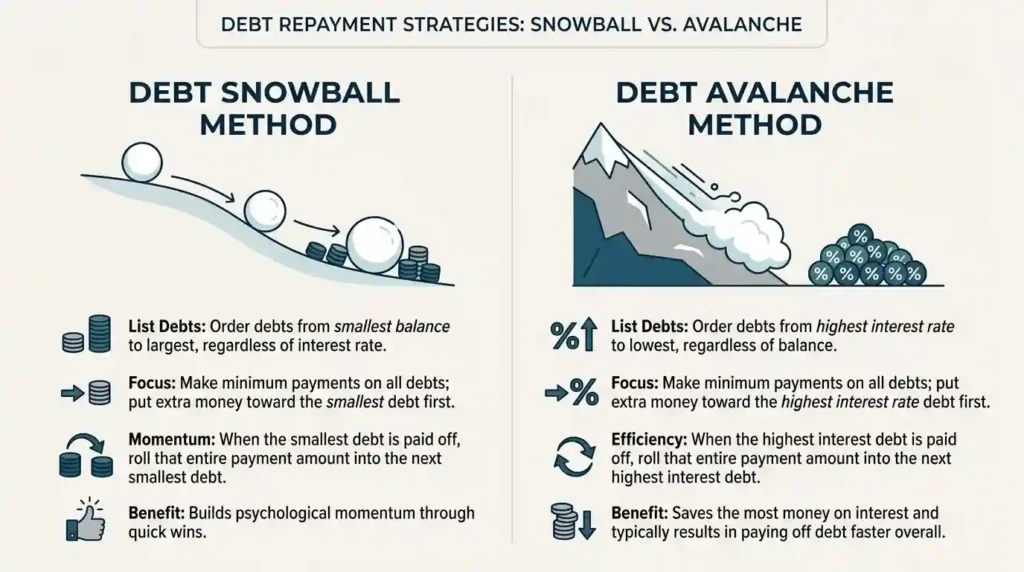
The debt snowball method has you list every debt from smallest balance to largest, ignoring interest rates entirely. You make minimum payments on everything except the smallest debt, which gets every extra dollar you can spare.
Once that smallest debt is paid off, you roll its payment into the next-smallest balance, and so on, building momentum as you go — like a snowball picking up size as it rolls downhill.
- Best for: People who need visible wins to stay motivated
- Main advantage: Fast psychological payoff from closing accounts early
- Main drawback: You may pay more in interest over time
What Is the Debt Avalanche Method?
The debt avalanche method orders your debts differently: highest interest rate first, regardless of balance size. You still pay minimums on everything else, but extra money goes toward whichever debt is costing you the most.
Mathematically, this is the more efficient path. With the average credit card interest rate sitting around 21% APR as of May 2026, according to Federal Reserve data, letting a high-rate card sit untouched while you knock out a smaller, cheaper loan can end up costing you real money in extra interest.
- Best for: People motivated by numbers and long-term savings
- Main advantage: Minimizes total interest paid
- Main drawback: The first debt you tackle might take a while to disappear, which can feel discouraging
Debt Snowball vs. Debt Avalanche: Side-by-Side Comparison
| Debt Snowball | Debt Avalanche | |
|---|---|---|
| Order of payoff | Smallest balance first | Highest interest rate first |
| Motivation style | Emotional wins, momentum | Logical, cost-focused |
| Total interest paid | Usually higher | Usually lower |
| Time to first "win" | Faster | Can be slower |
| Best suited for | People who’ve struggled to stick with a plan before | People who are disciplined and rarely lose motivation |
Neither method is objectively "wrong." The best plan is the one you’ll actually stick with for the months or years it takes to become debt-free.
Which Method Fits Your Situation?
If You Need Quick Wins to Stay Motivated
If you’ve started and abandoned a payoff plan before, the snowball method’s early victories can be the difference between quitting in month three and finishing the whole plan. Seeing an account hit a zero balance provides a concrete signal that the plan is working, even if the math isn’t perfectly optimized.
If You Want to Minimize What You Pay in Interest
If you’re the type of person who finds a spreadsheet more motivating than a mood, the avalanche method will typically save you money — sometimes hundreds of dollars, depending on how spread out your rates are. This gap tends to widen the longer your repayment timeline stretches.
In my own experience, I’ve generally preferred to avoid carrying debt at all, mostly because owing money to someone else has always felt like handing over a piece of control I’d rather keep. That’s part of why, when I do think through a payoff strategy, the emotional lift of closing an account fast matters to me almost as much as the math says it should — I understand the appeal of the snowball method even when the avalanche is technically the smarter choice.
If You’re Not Sure, Try a Hybrid Approach
Some people start with the snowball method to build momentum, then switch to the avalanche once they’ve built the habit of paying more than the minimum. There’s no rule against combining both — the goal is progress, not purity.
How to Get Started With Either Method
- List every debt you have, including the balance, minimum payment, and interest rate for each.
- Choose your order — smallest balance first for snowball, highest rate first for avalanche.
- Find extra money in your budget, even if it’s small, to put toward your target debt.
- Keep paying minimums on every other debt so nothing falls into default.
- Roll payments forward as each debt gets paid off, increasing the amount going toward the next one.
- Track your progress somewhere visible — a spreadsheet, an app, or even a printed chart — so momentum doesn’t fade.
With the average credit card balance standing at $6,610 as of the second quarter of 2026, most people paying off cards are working with more than one account, which makes choosing an order — and sticking to it — genuinely useful rather than just a mental exercise.
Frequently Asked Questions
Is the debt avalanche always cheaper than the debt snowball? In almost all cases, yes, because it targets the interest that’s costing you the most first. The difference in total cost depends on how varied your interest rates are — the wider the gap between your highest and lowest rate, the more the avalanche method saves you.
Can I switch methods partway through? Yes. Some people start with the snowball to build the habit of paying extra, then switch to the avalanche once they trust themselves to stay consistent without the quick wins.
Do these methods work for student loans and medical debt too? Both methods can apply to any type of revolving or installment debt, though student loans sometimes come with their own repayment programs worth comparing against a snowball or avalanche approach first.
What if I can’t afford more than minimum payments right now? Neither method requires extra cash to start — you’re simply choosing an order for when extra money does become available. In the meantime, focus on not adding new balances and keeping every account current.
Choosing between these two approaches isn’t really about finding the "correct" answer — it’s about being honest with yourself regarding what will keep you paying month after month. If you’re still building your budget around debt payoff, it might help to look at how a solid emergency fund can keep new debt from creeping back in while you’re working through the old balances.