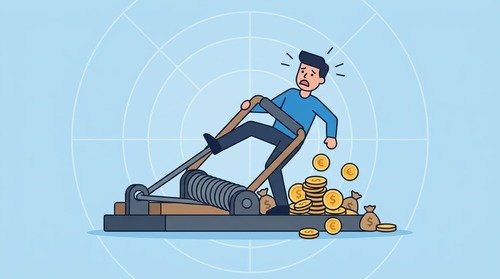
Ever paid your credit card bill on time every single month, only to notice your balance barely moved? That’s not bad luck. Minimum payments are built to keep you paying for a long time, and once you understand the math behind them, the whole system starts to make a lot more sense.
What a "Minimum Payment" Actually Covers
Most people assume the minimum payment is a modest slice of what they owe. In reality, it’s often barely enough to cover the interest that piled up that month, with a tiny bit left over for the actual balance.
Card issuers typically calculate your minimum payment one of two ways:
- A flat percentage of your balance (usually 1% to 3%), or
- A percentage of your balance plus that month’s interest and fees
Whichever formula results in the higher number is usually what you’ll owe, though issuers almost always set a dollar floor too, commonly between $25 and $35, even if the percentage would come out lower. So on a $5,000 balance, a 2% minimum works out to $100. That sounds manageable. What it doesn’t tell you is how much of that $100 is actually paying down what you owe.
Why the Math Works Against You
Here’s the part that surprises most people: with the average credit card interest rate sitting around 21% across all accounts as of early 2026, a huge chunk of every minimum payment goes straight to interest before it touches your principal.
Take a $5,000 balance at 22% APR (close to today’s typical rate for revolving balances). If your issuer requires 3% of your balance or $35, whichever is greater, and you never charge another dollar to the card, here’s what happens if you stick to the minimum:
| Payment Strategy | Time to Pay Off | Total Interest Paid | Total Amount Paid |
|---|---|---|---|
| Minimum payment only | ~14.7 years | $6,677 | $11,677 |
| Fixed $150/month | ~4.3 years | $2,798 | $7,798 |
| Fixed $200/month | ~2.8 years | $1,750 | $6,750 |
| Fixed $300/month | ~1.8 years | $1,022 | $6,022 |
That’s not a rounding error. Sticking to the minimum roughly doubles what you originally borrowed once interest is factored in, and stretches a debt that could be gone in under two years into a nearly 15-year commitment. On larger balances, the effect is even more extreme. A $10,000 balance at 20% APR paid at the minimum can take about 19 years and cost over $21,600 total — more than double the original amount borrowed.
This isn’t a fluke of one bad card. It’s how the math of compounding interest works whenever your payment barely outpaces what’s accruing.
Minimum Payment Calculator: See Your Real Payoff Timeline
See What Your Minimum Payment Is Really Costing You
Plug in your own numbers and find out exactly how long you’d be paying — and how much extra it would cost.
Why This Isn’t an Accident
It’s worth saying plainly: minimum payments aren’t designed to get you out of debt quickly. They’re designed to keep your account in good standing while the balance stays around as long as possible. Consumer advocates flagged this pattern decades ago, which is why the Credit CARD Act now requires issuers to show a "Minimum Payment Warning" on your statement, spelling out how long it would take to pay off your balance at the minimum and what you’d need to pay to clear it in three years instead.
If you’ve never noticed that box on your statement, it’s worth a look next time. It usually sits near the payment coupon, and it’s one of the most honest numbers your card issuer will ever show you.
Why Minimum Payments Feel "Safe" Even When They Aren’t
There’s a psychological piece to this too. A minimum payment feels responsible because you’re technically meeting your obligation every month. Nothing goes to collections, your credit score doesn’t take a hit, and the bill gets marked "paid." That sense of being current can quietly mask how little progress is actually happening underneath.
In my own experience, I’ve never been someone who’s comfortable carrying debt for long. Part of that comes down to not wanting anything with a monthly bill attached to have that much say over my decisions, whether that’s a lender, a card issuer, or anyone else. I still think there’s a smart, intentional way to use debt strategically down the road, but the minimum-payment trap is the opposite of that: it’s debt working on autopilot, quietly extracting more from you the longer you let it run.
How to Actually Break the Pattern
None of this means minimum payments are evil or that you’re careless for having paid them. Life happens, and sometimes the minimum is genuinely all you can manage for a stretch. What matters is not treating it as a long-term plan.
A few ways to start shifting away from minimum-only payments:
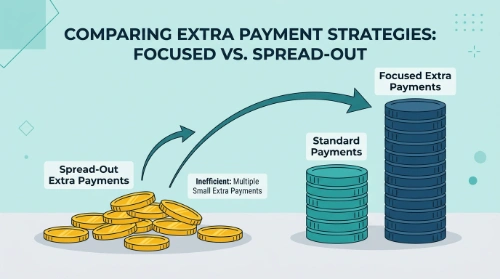
- Pick one fixed dollar amount above the minimum, even if it’s just $20 or $50 more, and commit to it every month regardless of what the statement says is "required."
- Target your highest-interest card first (the avalanche approach) if your goal is minimizing total interest paid.
- Automate the higher payment so it isn’t a decision you have to remake every month when money feels tight.
- Revisit your budget for one recurring expense you can trim and redirect that amount straight to your balance.
- Track the "time to payoff" number on your statement monthly. Watching it shrink is genuinely motivating in a way your balance alone often isn’t.
Even a modest increase, like going from a $100 minimum to a fixed $150, can shave years and thousands of dollars off what a card ultimately costs you, as the numbers above show.
Frequently Asked Questions
Does paying only the minimum hurt my credit score? Not directly, as long as you pay on time. Your score cares about on-time payments and your credit utilization ratio, not how quickly you’re paying off the balance. That said, a high, slow-shrinking balance keeps your utilization elevated, which can hold your score back indirectly.
Will my minimum payment change over time? Yes. Since most formulas are a percentage of your current balance, your required minimum shrinks as your balance shrinks, which is exactly why minimum-only payoffs stretch out for so long. The payment gets smaller just as slowly as the balance does.
Is it ever fine to pay just the minimum? Occasionally, if you’re in a genuinely tight month, paying the minimum keeps you in good standing. The issue is treating it as a routine strategy rather than a temporary fallback.
What’s the fastest way to see my real payoff timeline? Check the minimum payment warning box on your statement. It’s required by law and gives you the actual number of months or years at your current balance and rate.
Paying attention to that one box on your statement can be the difference between a card that quietly follows you for over a decade and one you’re free of in a couple of years. If you’re not sure which debt to tackle first, comparing the snowball and avalanche methods is a good next step.