You check your loan balance, make your payment, and check again next month — yet the number barely moves. That’s not you doing something wrong. It’s how amortization works when a big chunk of every payment goes toward interest instead of principal. The good news is that a few deliberate changes can shift that balance in your favor faster than you’d expect.
Why Your Balance Feels "Stuck"
Federal student loan debt is at a record high. The average federal borrower now owes around $39,600, and total student loan debt in the U.S. has climbed past $1.8 trillion. On top of that, interest rates for loans issued between July 2025 and June 2026 sit at 6.39% for undergraduate Direct Loans and 7.94% for graduate Direct Loans, and those rates are fixed for the life of the loan.
At that rate, a large share of your standard monthly payment early on covers interest, not the principal. As a result, your balance shrinks slowly at first, even though you’re paying on time every month. Once you understand that mechanic, the path to speeding things up becomes much clearer.
Step 1: Get a Clear Picture of Every Loan You Owe
Before you can attack your debt, you need to see it all in one place. Log into StudentAid.gov to pull your federal loan list, then check your credit report for any private loans that won’t show up there.
For each loan, write down:
- The servicer and account number
- The interest rate
- The current balance
- Whether it’s federal or private, and which loan type (Subsidized, Unsubsidized, PLUS, or private)
This step matters because federal and private loans behave very differently. Federal loans come with income-driven options and forgiveness programs; private loans generally don’t. Knowing which is which keeps you from applying the wrong strategy to the wrong loan.
Step 2: Pick the Right Repayment Plan Before You Optimize Anything Else
2026 has been an unusually disruptive year for federal repayment plans, so this step can’t be skipped. A federal court ended the SAVE Plan in March 2026, and the Department of Education is now transitioning roughly 7.5 million borrowers off it. If you were on SAVE, your servicer will send a notice giving you 90 days to pick a new plan — miss that window and you’ll be auto-enrolled into Standard Repayment or the new Tiered Standard Plan, whether or not that’s the cheapest option for you.
Meanwhile, a new income-driven option called the Repayment Assistance Plan (RAP) launched July 1, 2026, replacing most existing income-driven plans for anyone taking out new loans going forward. Depending on when your loans were disbursed, you may still be able to use Income-Based Repayment (IBR), which remains available for loans disbursed before July 2026.
Here’s why this matters for paying off debt faster: your repayment plan sets your baseline monthly payment and, in some cases, your minimum term. If you’re on a plan with a longer timeline than you actually need, any extra payments you make later are working against an unnecessarily stretched-out schedule. Confirm your plan first, then optimize on top of it.
Step 3: Make Extra Payments Work Harder
Once your plan is set, the fastest lever you control is paying more than the minimum — but how you do it matters.
Always Direct Extra Payments to Principal
Most servicers apply extra money to next month’s payment by default instead of reducing your principal. Log into your servicer’s portal and look for an option like "apply extra payment to principal," or call and ask them to do it manually. Skipping this step means your extra dollars barely help.
Try the Biweekly Payment Trick
Splitting your monthly payment in half and paying every two weeks results in 26 half-payments a year — the equivalent of one extra full payment annually — without requiring a lump sum. Because that extra payment goes toward principal, it chips away at both your balance and the total interest you’ll pay over time.
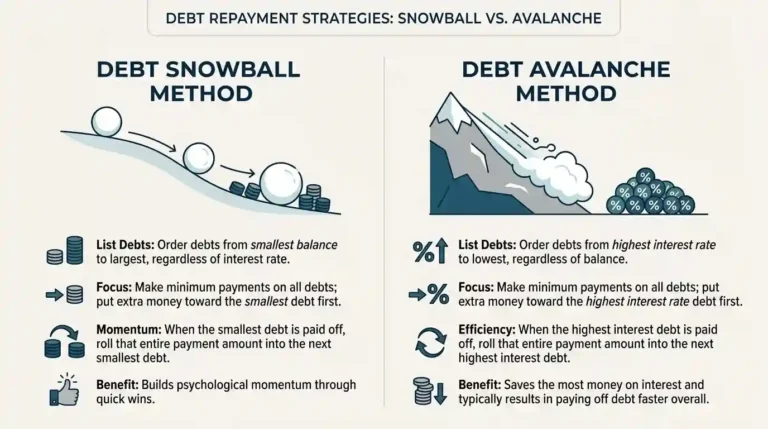
Choose Avalanche or Snowball, Not Neither
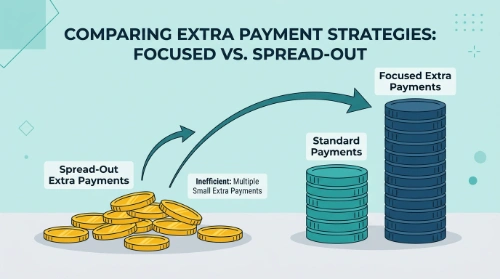
If you have multiple loans, put any extra money toward one loan at a time instead of spreading it thin:
- Debt avalanche: target the highest-interest loan first. This saves the most money mathematically.
- Debt snowball: target the smallest balance first. This builds momentum through quick wins.
Either approach beats making the same small extra payment across every loan, because that dilutes your progress without actually closing anything out.
In my own experience, I’ve learned that spreading effort across too many things at once — whether that’s side projects or, in this case, debt payments — usually backfires. I get further by picking one loan, or one goal, and giving it my full attention before moving to the next.
Step 4: Decide Whether Refinancing Makes Sense
Refinancing replaces one or more loans with a new private loan, ideally at a lower rate. It can meaningfully cut your total interest, but it also means giving up federal protections like income-driven repayment and Public Service Loan Forgiveness. That trade-off is why refinancing fits some borrowers and not others.
| Strategy | Best For | Watch Out For |
|---|---|---|
| Extra principal payments | Any borrower who wants to stay on a federal plan | Requires servicer to apply funds correctly |
| Biweekly payments | Borrowers paid biweekly who want steady, automatic progress | Set it up as automatic to avoid missed cycles |
| Debt avalanche/snowball | Borrowers with multiple loans at different rates | Avalanche saves more; snowball motivates more |
| Refinancing | Borrowers with strong credit, stable income, and no plans to use federal forgiveness | Permanently forfeits federal IDR and PSLF eligibility |
If you’re pursuing Public Service Loan Forgiveness or think you might need an income-driven plan down the road, refinancing usually isn’t worth the risk. If you have private loans only, or high-rate federal loans with stable income and no forgiveness path in sight, it’s worth comparing quotes from a few lenders.
Step 5: Find Extra Money Without Overhauling Your Whole Budget
You don’t need a dramatic lifestyle change to speed up payoff — small, consistent redirection of money adds up.
- Apply windfalls directly to principal. Tax refunds, bonuses, and cash gifts can shave months off your timeline when they go straight to your loan instead of your spending account.
- Check for employer student loan assistance. A growing number of employers offer a monthly contribution toward employee student loans as a benefit; ask HR whether yours does.
- Automate a small recurring "extra payment." Even an additional $50 a month, applied to principal, reduces both your timeline and the total interest you’ll pay.
None of these require you to overhaul your entire budget. They just require directing money you might otherwise not notice toward the one goal you’ve already decided matters.
Frequently Asked Questions
Will paying off my student loans early hurt my credit score? Usually not in any lasting way. You might see a small, temporary dip because it changes your credit mix, but responsible payoff history and lower overall debt typically help your score more than an early payoff could hurt it.
Is it better to pay off student loans or invest extra money? It depends on your interest rate compared to expected investment returns, plus how much risk you’re comfortable with. Many people split the difference — paying down high-rate loans aggressively while still investing enough to capture any employer retirement match.
What happened to the SAVE Plan in 2026? A federal court ended the SAVE Plan in March 2026, and the Department of Education is transitioning enrolled borrowers to other repayment options, including the new Repayment Assistance Plan (RAP) that launched July 1, 2026. If you were on SAVE, check your servicer’s messages for your transition deadline.
Can I change my repayment plan more than once? Yes. You can typically switch federal repayment plans as your income or goals change, though processing can take a few weeks, so plan ahead if you’re close to a deadline like the current SAVE transition window.
Getting your loans paid off faster isn’t about one dramatic move — it’s about stacking a few of these habits and letting them compound over months. If you’re also working through other debt alongside your student loans, it might help to map out a full payoff plan next.