Your income doesn’t arrive on a schedule, but your bills do. That mismatch is the single biggest financial challenge of working for yourself, and it’s why so many freelancers feel like they’re managing money with no map. The good news is that a few structural changes can turn unpredictable income into something you can actually plan around.
Why Freelancing Changes the Rules of Personal Finance
When you work a W-2 job, taxes come out automatically, retirement contributions might get matched, and a paycheck lands on the same day every two weeks. None of that happens by default when you’re self-employed. You become your own payroll department, your own HR team, and your own safety net.
That’s not a small shift. It means the standard budgeting advice built for steady paychecks needs some adjusting before it actually works for you.
Build a Budget Around Your Lowest Month, Not Your Average One
A common mistake is budgeting off your average monthly income. Averages hide the risk. If you made $8,000 one month and $2,000 the next, your average is $5,000, but your bills still show up in the $2,000 month.
Instead, try this approach:
- Find your baseline. Look back at your worst three months from the past year and use the lowest one as your "survival number."
- Build your core budget around that number. Rent, groceries, insurance, and minimum debt payments should fit inside your leanest month.
- Treat everything above baseline as overflow. Extra income in a strong month goes toward savings, taxes set-asides, or paying down debt — not lifestyle upgrades.
This approach takes the guesswork out of a good month versus a bad one, because your fixed costs are never depending on a good month to begin with.
In my own experience, the pressure of freelance income does not stay purely financial. Money worries can bleed into your mood and confidence in a way that is easy to underestimate until you are living it, and I think that hits younger self-employed workers especially hard because so much of their identity gets tied up in how the business is doing that month. Naming that link between cash flow and mental state has helped me treat a slow month as a temporary number to solve, rather than a verdict on how things are going overall.
Understanding Self-Employment Tax (This Is the Part That Surprises People)
Here’s the tax bill that catches almost every new freelancer off guard: self-employment tax. According to the IRS, this tax funds Social Security and Medicare, with a combined rate of 15.3%, split into 12.4% for Social Security and 2.9% for Medicare. As a self-employed person, you’re paying both the "employee" and "employer" halves that would normally be split with a company.
A few details matter here:
- The tax applies to net earnings above $400, and only 92.35% of your net self-employment earnings are actually subject to it, not the full amount.
- The Social Security portion only applies up to a wage base, which rises to $184,500 for 2026, up from $176,100 the year before, according to Black Inc Tax Services. Once you cross that threshold, only the 2.9% Medicare portion continues on the rest.
- You can deduct half of what you pay in self-employment tax when calculating your adjusted gross income, which softens the blow somewhat on your income tax bill.
Paying Quarterly Instead of Once a Year
Because nobody is withholding tax from your income throughout the year, the IRS expects self-employed workers to send in estimated payments four times a year instead of settling everything in April. According to Fidelity, for the 2026 tax year those payments are due April 15, June 15, and September 15 of 2026, with the fourth payment due January 15, 2027.
A simple habit that prevents a scramble at each deadline: every time you get paid, transfer a percentage (many freelancers set aside 25–30%, adjusted for your actual tax bracket and state) into a separate savings account labeled specifically for taxes. Never touch it for anything else.
Saving for Retirement Without an Employer Plan
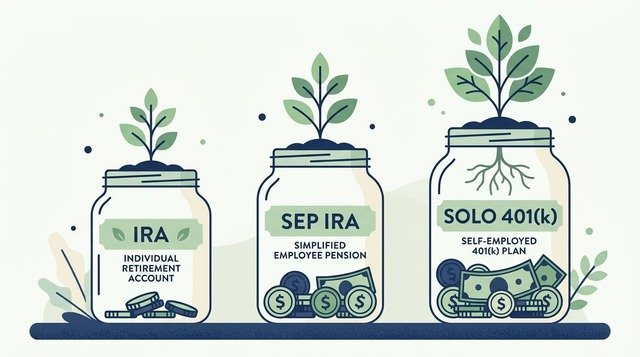
No employer means no automatic 401(k) enrollment and no match. That doesn’t mean retirement savings are off the table — it means you have to set the account up yourself, and the options available to self-employed people are actually generous.
| Account Type | Who It’s Best For | 2026 Contribution Limit | Key Trade-Off |
|---|---|---|---|
| SEP IRA | Freelancers who want simplicity and variable contributions | Up to $72,000, or 25% of compensation, whichever is lower (source) | Easy to set up, but contribution must be the same percentage for any employees you have |
| Solo 401(k) | Self-employed people with no full-time employees who want to save aggressively | $24,500 as an employee, with a combined employee-plus-employer maximum of $72,000 (source) | More paperwork than a SEP IRA, but allows higher contributions at lower income levels |
| Traditional or Roth IRA | Freelancers just starting out or supplementing another plan | $7,500 per year, or $8,600 if you’re 50 or older (source) | Lowest limit, but simplest to open and manage on your own |
If you’re inconsistent about saving, automating a small transfer to any of these accounts after each invoice gets paid removes the decision-making from the equation entirely. Something is always better than waiting for a "good enough" month that keeps getting pushed back.
Protect Yourself Where an Employer Used to
A few categories of protection that come standard with many jobs need to be handled manually when you’re self-employed:
- Health insurance. Look into marketplace plans, a spouse’s plan, or professional associations that offer group rates to freelancers.
- Disability insurance. If an injury or illness stopped you from working for three months, would your savings cover it? If not, a short-term disability policy is worth pricing out.
- Contracts and deposits. Late-paying clients are one of the most common causes of freelance cash-flow trouble. A signed contract with a deposit before work begins protects your time and your bank balance.
Common Mistakes Freelancers Make With Money
- Spending based on top-line income instead of what’s left after taxes. A $5,000 invoice is not $5,000 in spending money once self-employment tax and income tax are accounted for.
- Mixing personal and business accounts. This makes it nearly impossible to know your real profit margin or prepare accurate taxes.
- Skipping the emergency fund because income already feels unpredictable. In fact, that unpredictability is exactly why the buffer matters more, not less.
- Waiting until tax season to think about taxes at all. By then, the money that should have been set aside quarterly is often already spent.
Frequently Asked Questions
How much should freelancers set aside for taxes? Most freelancers set aside 25–30% of net income for combined federal self-employment tax and income tax, though the right number depends on your tax bracket, state, and deductions. A tax professional can help you land on a more precise figure for your situation.
Do freelancers need a separate business bank account? It’s not always legally required for sole proprietors, but it’s strongly recommended. Separating accounts makes it far easier to track deductible expenses, calculate quarterly taxes, and see your actual profit.
Can freelancers get an emergency fund started with irregular income? Yes — the process just looks different. Instead of setting a fixed monthly savings amount, set a percentage of each payment (even 5–10%) to move automatically into savings, so the fund grows in proportion to what actually comes in.
Is a SEP IRA or Solo 401(k) better for freelancers? It depends on income level and consistency. A SEP IRA is simpler to manage with fluctuating income, while a Solo 401(k) allows for higher contributions at lower income levels because of the employee-deferral portion. Comparing both against your expected income for the year is worth the extra ten minutes.
Freelancing hands you control over your schedule, but it also hands you every job a traditional employer used to quietly handle in the background. Once the systems above are in place, they mostly run on autopilot — which is really the whole point.
If you’re still working through how to handle debt alongside irregular income, it’s worth taking a closer look at how the debt snowball and avalanche methods compare before choosing one.